
Why Your Child Keeps Switching Interests (And What to Do About It)
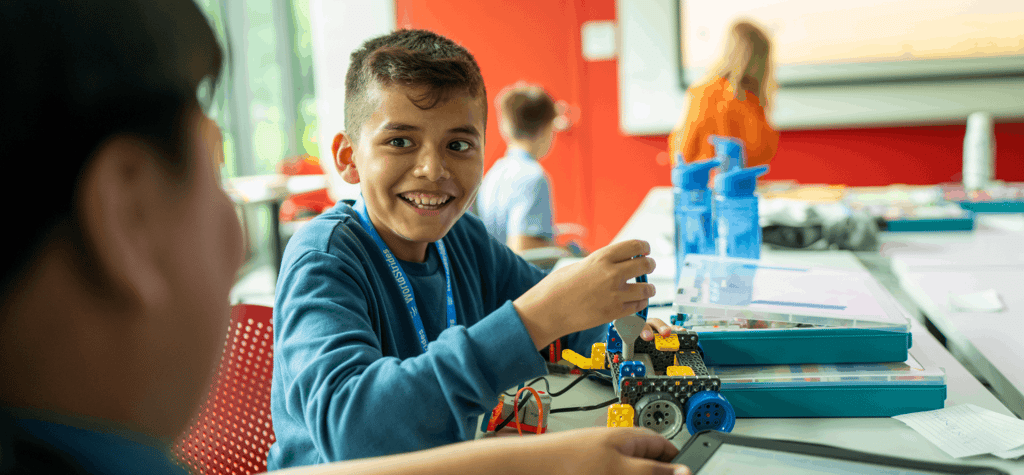
Here's a scene most parents recognize: your child discovers something new, like dinosaurs, coding, drawing, drumming, and for a few weeks it's everything. Then it quietly disappears, replaced by the next thing. Before assuming it's a short attention span, it's worth looking at what the research actually says. That pattern is healthy because it's exactly what interest development is supposed to look like in kids.
The activities children choose outside the classroom — hobbies, extracurriculars, and free-time pursuits — do more than fill their time between kindergarten and eighth grade. They shape how children see themselves. Developmental research from the NCBI shows that the beliefs children form about their own abilities and activity preferences — whether they're "a math person," a creative kid, an athlete — take root during the elementary years. By middle school, interests start to solidify into early identity formation.
So how do you support your child's interests without accidentally turning the whole thing into homework? Here's what the science says.
Interest develops in phases
Researchers Suzanne Hidi and K. Ann Renninger spent decades studying how people develop passions, finding that interest moves through stages: something sparks curiosity, then that curiosity gets maintained through meaningful engagement, then the person starts seeking it out on their own, and eventually they'll push through difficulty to keep going.
"Once interest is triggered and sustained, information search activates the reward circuitry and becomes rewarding in itself." — Renninger & Hidi (2022), Theory Into Practice
Here’s the part most relevant to parents: in the early stages, kids need you to design the conditions. They can't get interested in something they've never encountered. But once an interest starts to take root, the role shifts — they need room to explore more than they need more structure. The switching and cycling that looks like distraction is often just the early stages of the process doing its work.
Elementary school: expose, explore, and let it breathe
For younger kids, the formula is simple: more experiences, less pressure. The American Academy of Pediatrics is emphatic on this point. Its 2018 clinical report in Pediatrics (reaffirmed in January 2025) makes the case that unstructured, child-directed time isn't a break from development. It is development.
"When play is allowed to be child driven, children practice decision-making skills, move at their own pace, discover their own areas of interest, and ultimately engage fully in the passions they wish to pursue." — AAP Clinical Report: The Importance of Play, Pediatrics (2007)
This type of development happens in museums, libraries, backyards, maker spaces, community theater, youth sports, and anywhere children are allowed and encouraged to explore. The point is variety and low stakes. A child who cycles through five interests before settling on one isn't failing to commit. They're doing exactly what this stage calls for.
Try this: Instead of asking "what do you want to be when you grow up?", try asking "what are you curious about right now?" It's a small shift, but it takes the pressure off and often gets you a much more honest answer. The real signal isn't what your child says they like when you ask. It's what they return to on their own, without being reminded.
Middle school: from curiosity to identity
The stakes begin to shift in middle school. Research in developmental psychology shows that at this age, kids start defining themselves by their interests: "I'm a theater kid;" "I'm into science." These may feel like transient labels, but they're doing real psychological work, providing stability and a sense of self during one of the more turbulent developmental periods in childhood.
There's also something worth knowing about this age and academics. Research from PMC has found that middle school is the window where interest in STEM subjects drops most sharply, for both boys and girls, often never recovering. During these years, active support for curiosity and meaningful exposure can make a real difference. It's a real intervention.
The social piece matters too. Studies have found that kids who participate in activities at this age tend to develop more prosocial, academically-oriented friend groups. The activity itself often determines who your child spends time with, which shapes a great deal else.
The goal for middle school isn't for your child to find "the thing" they'll do forever. It's to find at least one activity that gives them a skill to develop, a role to grow into, and people who care about the same things they do. That combination is worth a lot at this age.
Try this: Pay attention to how your child describes themselves to others. The labels they reach for tell you something real about where their identity is taking shape. When you hear one that resonates, lean into it. Ask them what they love about it and find more opportunities in that direction. Find chances to verbalize support and recognition: “you're really becoming someone who knows a lot about this.” At this age, being seen in a specific way by loved ones isn't just encouraging. It's part of how the identity actually forms.
What the research says about overscheduling
Parents often worry about doing too much. And while that concern isn't wrong, the research is more nuanced than the usual headlines suggest.
A study published in PMC that tested the overscheduling hypothesis directly found "negligible evidence for deleterious effects of high extracurricular involvement per se." What caused the most harm wasn't the number of activities. It was parental criticism and pressure attached to those activities.
A separate study of nearly 900 children ages 9 to 13 found that the biggest driver of kids wanting more free time was screen time, not scheduled, organized activities. Children logging three or more hours of screen time daily were nearly three times more likely to feel overscheduled than those who weren't. More often than not, what's crowding out free play isn't the soccer practice — it's what happens before and after it.
So, the question for parents isn't really “are we doing too much?” It's “are we doing the right things, in the right spirit, with enough room left over?” Clearing space doesn't always mean cutting activities. Sometimes it means taking a closer look at screen time instead.
Your most important job: get out of the way (thoughtfully)
There's a body of research in developmental psychology called Self-Determination Theory that has a lot to say about parenting and motivation. The short version: children who feel like their interests are genuinely their own — not something they're doing to please you or avoid conflict — are more persistent, more resilient, and more likely to keep going when things get hard.
"Autonomy-supportive parental behavior fosters intrinsic motivation and provides the opportunity for the child's satisfaction of the needs for autonomy, competence, and relatedness." — PMC: A Little Autonomy Support Goes a Long Way, Child Development (2021)
In practice, this looks like offering choices instead of directives. It looks like asking questions instead of giving instructions. And it sounds like "I love watching you do this" far more often than "you need to practice more." Research on fifth graders found that children in autonomy-supportive households showed higher intrinsic motivation and stronger academic performance than those in more controlling ones. The way you respond to your child's interests matters as much as what those interests are.
This doesn't mean being hands-off. Kids who are just beginning to explore something still need structure: introductions to material, help finding communities, encouragement through the first rough patches. The goal is to make sure they’re motivated by their own genuine interests, not the desire to meet your expectations.
A few things worth keeping in mind
- Notice what your child returns to on their own. Spontaneous re-engagement is the best signal of emerging interest.
- Variety matters more than volume. Two or three genuinely chosen activities will do more than five that feel obligatory.
- Interest-switching in elementary school is normal and healthy. By middle school, some sustained engagement in one area starts to matter.
- Libraries, parks, and recreation departments are genuinely underrated. Free, low-pressure, and full of exposure opportunities.
- Screen time is the real scheduling problem, not activities. Look there first.
- The phrase "I love watching you do this" is one of the most research-supported things a parent can say. Use it often.
You don't need to orchestrate your child's passion. You need to create enough space, enough variety, and enough emotional safety for it to emerge on its own. According to the research, that's actually more than enough.