
Making Makers: Trends in Educational Technology & Instruction

The recent release of the NMC Horizon Report: 2015 Higher Education Editionserves as an appropriate time to reflect on some of the most important technological trends impacting the K-20 landscape. While the fifty page NMC reportfocuses on broad higher education trends, the thinking around “Digital Strategies” is immediately applicable to all educators regardless of the age of thelearners that they serve.
“Digital Strategies” are not necessarily technologies; rather, these are methods or platforms that amplify teaching and learning. The NMC report lists sixtrending “Digital Strategies”, including “Bring Your Own Device”, the “ Flipped Classroom”, “Games &Gamification”, “Location Intelligence”, “Makerspaces”, and “Preservation/Conservation Technologies”. While each of these trends could positively impactpedagogy, I want provide some focus on “Makerspaces” and the “Maker Movement”.
Most associate the inauguration of the so-called “Maker Movement” with the success of the launch of the Maker Faire in 2006. In general though, the “MakerMovement” represents a focus on higher-order problem solving and critical thinking skills developed through hands-on, creative, and design-based learningevents. “Makerspaces” are simply dedicated spaces with necessary tools that enable the cross-disciplinary collaboration of individuals to innovate anditerate solutions to pressing challenges or to simply create. To learn more, read “ Learning by Making: Agency by Design and the Rise of the Maker-Centered Education”.
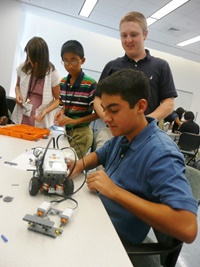
The “Maker Movement” is not simply a physical activity—a way of doing. It is more properly a way of thinking that focuses on creativity, experimentation,and intellectual openness. Thus, while helpful, one does not necessarily need “makerspaces” to cultivate “Design Thinking” in students. “Design Thinking”is a mindset that is ultimately optimistic about the ability create and design solutions. (Note the great resources at the “D School” at Stanford University.) Most importantly, “Design Thinking” is a process that can be taught in anysubject area and with or without the benefit of a “makerspace”. This process involves a purposeful and structured five phase approach to ideation thatbegins with Discovery and then proceeds through Interpretation, Ideation, Experimentation, and Evolution.
Ultimately, the ability to “make makers” doesn’t require technological innovation. Michelangelo didn’t have an iPad; Socrates didn’t have a “makerspace”.What they had in common was the ability to be intuitive and the freedom to experiment and fail. If your school has the benefit of a “makerspace”—awesome;but every teacher can empower students to become design thinkers regardless of the physical and technological tools at their disposal.