
GPA or Extra Curricular – Which Matters Most to Employers?

According to The Chronicle of Higher Education, the experiencestudents gain through internships, jobs, volunteering and extra-curricular activity is more important to employers than GPA.
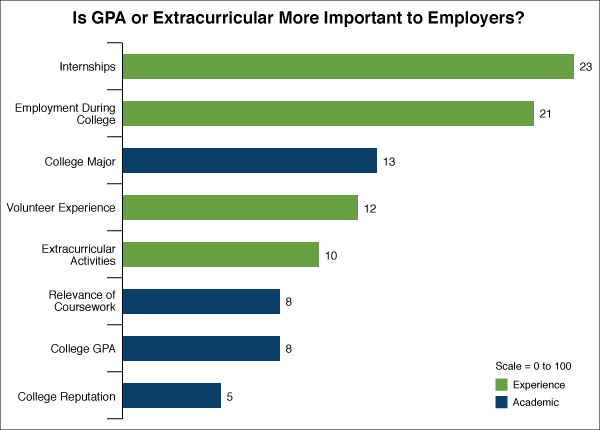
Many experts surmise that involvement in a variety of activities make a student well-rounded and accustomed to working with people. The activities astudent pursues also help demonstrate their drive and values. Peter Cappelli, a Wharton professor and author of a paper on job skills, weighs in, saying, “Work experience is the crucial attribute that employerswant, even for students who have yet to work full-time.”
But of course not all industries are alike. The Chronicle says, “Media and communications companies are gaga for internships… Health carecompanies care the most about your major, and white-collar businesses care the most about your GPA.”
Brazen Careeristagrees that hands-on work experience is crucial, saying many employers feel real-world experience is the only thing standing between some graduates andtheir dream jobs. Brazen and other sources tout the value of internships, but don’t forget to explore experiential summer learning courses whensearching for career experience. Courses like Envision’s may provide more high-level, hands-on experience in a student’s dream field than they would findin a low-level internship – and in less time.
Forbessays college majors and graduate degrees also matter. The three degrees most in demand for the class of 2015 are business, engineering, andcomputer/information sciences. But cutting across all majors and degrees, employers want new-hires who can work well on teams, and who are decisiveproblem-solvers. Here is how the Forbes research ranked employers’ priorities:
- Ability to work in a team structure
- Ability to make decisions, tied with problem-solving skills
- Ability to communicate verbally
- Ability to plan, organize and prioritize work
- Ability to obtain and process information
- Ability to analyze quantitative data
- Technical knowledge related to the job
- Proficiency with computer software programs
- Ability to create and/or edit written reports
- Ability to sell and influence others
Forbesgoes on to say, “The trick is to demonstrate that you have those skills through your cover letter, résumé and interview.”
As educators, we can create class projects in which students have opportunities to be team members or leaders, and assign tasks requiring planning andprioritization. Remind them that these types of experiences will make valuable additions to their resumes and job interview discussions.