
Advocating for Your Craft: The Power of Experiential Learning

The following draft is pending publication in the Winter 2015 edition of Mid-Atlantic Currents and is used with permission.
Experiential Learning’s time is now.
At a macro level, the educational institutions and methods of the present appear ill-equipped to prepare students to compete and collaborate in theemerging global, 21st Century. At a micro level, domestic and international assessments reveal that many individual students are being equippedfor a world that no longer exists. The inability of the existing educational institutions to transfer the critical skills of the future—communication,creativity/innovation, critical thinking, and collaboration--to students is the great challenge of our generation.
Against this backdrop, advances in neuroscience, cognitive psychology, and pedagogical research are beginning to shape a compelling definition of 21 st Century learner needs. In order to succeed in the 21st Century, students require a learning ecosystem that is defined by thefollowing five core pillars:
-
 Learner Centric – The design of the learning event is personalized and adaptive.
 - Participatory – The learning event is active and enables multi-sensory engagement.
- Social – The learning event fosters collaboration and connection to a human being or a community.
- Brain-Based – The learning event is purposely designed to amplify cognition.
- Enables “Mastery” – The learning event enables the learner to transfer knowledge and skills by applying them in new contexts.
The traditional classroom struggles to deliver on nearly all of the above design elements. Properly developed, delivered, and assessed, experientiallearning methodologies present a powerful instructional option that can prepare students for the world to come.
Experiential methodologies include historic options like service learning, wilderness education, internships, and cross-cultural immersion among others.However, broad options like inquiry-based learning and problem and project-based learning are also intimate components of an experiential design. Researchdemonstrates the importance of these methods due to their ability to drive up students emotional, social, and cognitive engagement levels. The importantstudy by G. Yair in 2000 found that the highest levels of cognitive engagement resulted from hands-on learning methods or group work compared to othermethods like lecture, class discussion, and individual seat work.[1]
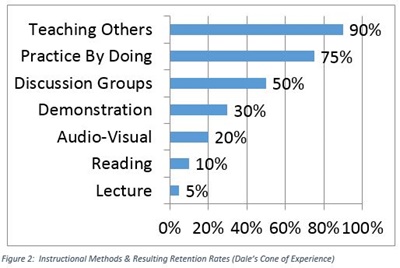 In the 1960’s, Edgar Dale laid much of the foundation in comparing instructional methods against retention results, in what would eventually be labeled his“Cone of Experience”.[2]Similar to the Yair study, his results found that learners retained information if they were actively involved in the material or organized in workinggroups (see chart).
Continued research in this area consistently demonstrates the importance of experiential learning. A 2006 report from the Federation of American Scientistsfound that students recall only 10% of what they hear (i.e. lecture), 20% of what they read, but 90% of what they actively do.[3]Additionally, a recent study of student performance in undergraduate STEM courses found that students in traditional lecture courses were 1.5 times morelikely to fail than students in courses that supported active learning. The same study also found that student’s exam scores increased by 6% for thosestudents in classrooms using an active learning pedagogy.[4]
Experiential learning methods currently enjoy increasing validation from both research and practice. Done correctly, experiential learning methods willdrive up learner engagement and enable the equipping of those students with the skills, abilities, and attitudes required of 21st century globalleaders. To become successful advocates, practitioners of experiential learning should acquaint themselves with the research, align their instructionaldesign accordingly, build robust learner assessment capabilities, and then publicize their results.
[1]Yair, G. (2000). Not just about time: Instructional Practices and Productive Time in School. Educational Administration Quarterly , 36(4), 485-512.
[2]Dale, Edgar. Audio-Visual Methods in Teaching, 3rd ed., Holt, Rinehart & Winston, New York, 1969, p.
108
[3]Penenberg, Adam. (2010). How Video Games are Infiltrating—and Improving—Every Part of Our Lives. Fast Company Magazine, December 2010.
[4]Freeman, Scott et al. (2014). Active Learning Increases Student Performance in Science, Engineering, and Mathematics. Proceedings of the NationalAcademy of Sciences, Early Edition. Retrieved on Jun 16, 2016 athttp://iteachem.net/wp-content/uploads/2014/05/Freeman-S-Proc-Natl-Acad-Sci-USA-2014-Active-learning-increases-student-performance-in-science-engineering-and-mathematics.pdf.